
Interim & Fractional Sales Leadership
When continuity, execution, or momentum can’t wait.
Leadership Gaps Create Revenue Risk
When sales leadership is absent, misaligned, or stretched too thin, revenue performance degrades quickly—not because teams lack effort, but because execution lacks direction.
Interim and fractional sales leadership ensures continuity, accountability, and forward motion during periods of transition, growth, or restructuring.
Sales Leadership Models — and the Trade-Offs that Matter
Sales leadership needs — and trade offs — change dramatically as organizations scale.
Small businesses often rely on owner-led or first-time sales managers. Mid-market companies may need experienced Directors or VPs to stabilize execution. Enterprise organizations frequently require interim senior leadership — VP, SVP, or CRO-level — to manage transitions, correct course, or lead through change.
The matrix below illustrates the most common sales leadership models, the risks inherent in each, and where fractional versus interim leadership delivers the highest return based on scope, urgency, and organizational complexity.
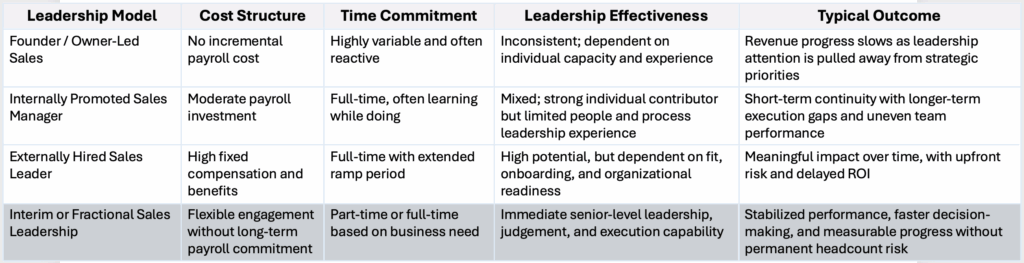
Interim engagements are most often used in mid-market and enterprise environments where leadership continuity, authority, and execution speed are critical—particularly during transitions, restructures, or executive searches.